BYU lost. I'm all emotional about it. Why do I do this to myself? Where is my catharsis?
...
But just think how sweet that win would've been...
Ok, so that thought makes it hurt all the worse, but that sweetness.. I mean, that sweetness.
I guess that's why I let this happen. Without risking emotional devastation...
...yeah, without that kind of devastation, there is no sweetness.
But also right now there is no sweetness. Just agony.
There is no joy in Mudville, etc.
Ok, I'm going to bed.
Saturday, December 21, 2013
Thursday, December 19, 2013
About the Author and Other Questions of Identity
I recently made some changes to the format of my blog, and in doing so decided to add an "about the author" tab. But then I sat down to write about the author, and ran into trouble. See, how do you actually define identity? I don't know how to answer that question, but what here follows are my attempts to wrestle with that question.
I don't really know what to write here. I feel like an unspoken purpose of this blog is to explore questions of identity and my ruminations on the same. To try and sum up myself in one "about the author" tab would be an exercise in futility, because no matter what or how much I write, it can't hope to be more than an inaccurate over-generalization of who I am.
To that point, can I even really know who I am? Is any definition of self wholly accurate? I don't think it ever can be. So what's the point?
I suppose I could just give you a list of things describing me. You know, typical first date material:
- I'm agrad student at Purdue getting my PhD in English, emphasizing in rhetoric and composition | a English professor at Sacramento State teaching courses in composition, rhetoric, and professional writing | an English professor at BYU teaching rhetoric and composition.
- I teach college level writing
- I'm 6'2"
- I'm an active and practicing Mormon
- I like reading YA novels
- I like to sleep and run, though not at the same time
- My literary heroes are the bishop in Les Miserables, Joe Gargery in Great Expectations, and Atticus Finch in To Kill a Mockingbird.
- If I had all the money in the world and could do anything, I'd probably continue on my current life trajectory, but I'd probably eat out more.
- My favorite dessert is my Mom's cherry pie. (not any cherry pie, my Mom's)
- I love sports, especially BYU sports and the Utah Jazz and the Chicago Cubs and the New York Yankees.
- My favorite TV show is Psych
- I love flowers and gardening and mowing the lawn
I could continue on in this vein, but is this really who I am? At my deepest darkest center does this really get at the true definition of Samuel James Dunn? I guess there are other things we could talk about here like personality tests and the like.
Type A or Type B?
Type B.
Color code test?
White-blue
Myers-Briggs Test?
INFP (which means I'm Luna Lovegood, Frodo Baggins, Luke Skywalker, and the Tardis)
I feel like a lot of life is dedicated to trying to nail down our identities. Whenever we apply for anything -- jobs, graduate schools, apartments, loans, etc. -- we are forced to include some kind of identity-defining information: a resume and cover letter, a CV, a credit history, a police affidavit reporting past criminal behavior, etc., but aren't all of those things just a shadow of something deeper. Does the fact that worked as a security guard at a museum of art for 3 years really tell you that much about who I am?
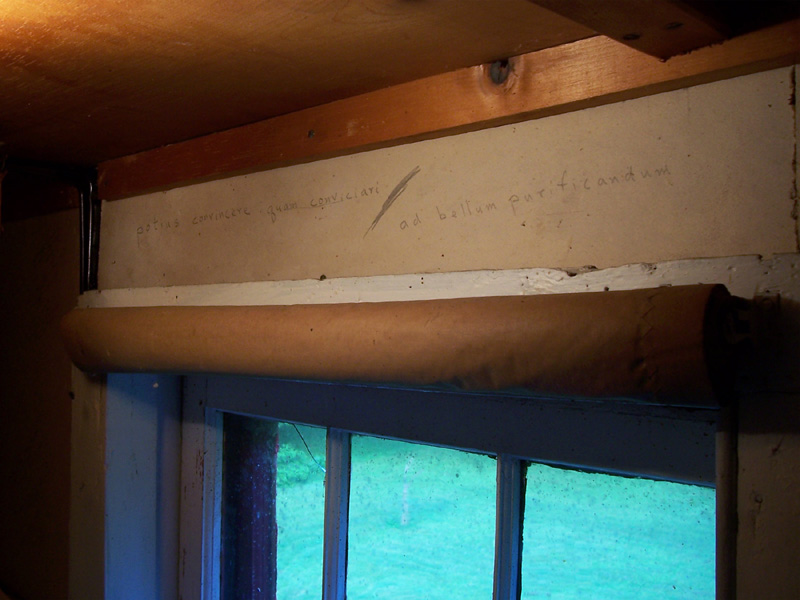
Not only do we define ourselves in those professional and higher stakes situations, but we also do it in less serious situations. Social networking sites are constantly encouraging you to define yourself, both explicitly and implicitly. On twitter I describe myself thus, "I crossword puzzle with a pen. I read in the bathroom. I do what I want. potius convincere quam conviciari / ad bellum purificandum." Obviously I don't really think that crossword puzzles and bathroom reading are who I am at my very essence, and my defiant assertion that I do what I want might lead someone to read the whole description as deliberately unhelpful as an identity-defining enterprise. But does my refusal to kowtow to that particular social pressure and instead give some pithy, cliched description of what I like and what I do and what I tweet about actually illuminate some aspect of my identity?
I included above a picture of me that some have said is instructive as to my persona. I have recently started doing some occasional work writing content for G5 Leadership, and this is the picture that was included with my short biography. But does this picture help in describing me? In the picture I'm chewing on a matchstick, I'm talking on the phone, I'm wearing a small child's beanie which doesn't quite fit on my head, I have a concerned/contemplative look in my eye, and at first glance it might look like I have my finger in my nose. But what does any of that tell you about me? What identity is constructed in your mind by looking at that picture? Does the fact that I normally wear glasses change that identity? Does my lack of glasses in this picture make the picture a lie because it isn't representative of what I normally look like? Is my identity affected by my outward appearance, or is my identity some ethereal, unembodied idea that exists outside of corporeal form? If so, should I remove the picture from this post, because it's just a physical mask of the unknowable?
If identity is some noncorporeal entity that exists outside of the cognitive world, why then are we asked to explain ourselves so often? Why is it that when a dead body shows up at the morgue friends and/or family "identify" the body based on physical appearance. (Does that kind of thing actually happen or am I just taking my cues on reality from crime TV? Does telling you that I watch crime TV affect how you perceive my reality?)
Several times now I've asked about how certain aspects of what I do or look like affect your perception, dear reader, of my identity. Is my identity based off of how other perceive me? If so, is it possible to have identity in a vacuum? (If a tree falls in the forest, etc.) When I'm sitting in the tub in my apartment reading Harry Potter all alone, am I identityless? I would say that no, I'm not, but is that only because I am consciously thinking about myself as an identified being? In which case that puts me in the position of an outsider observing my own identity, which then leads back to seeing identity as some intangible something.
This was the end of my abstract somewhat metaphysical thoughts that were born of me trying to write "about the author." I realize that all this talk of identity and "who am I" might make it seem like I'm undergoing some kind of identity crisis here. I'm not. I feel like I have a pretty good handle on who I am, even if I'm not entirely sure how to articulate that pretty good handle. Also, I'm pretty convinced that most aspects of what we call "identity" are fluid and changeable, which is part of why it can be so hard to pin down. To this point I think that in many cases our social fascination with authenticity and hypocrisy (are we really who we say we are?) is an unhelpful one. But unhelpful for what? This whole exploration has left me pondering a question that I posed early on:
What's the point? Why is all of this so important? What good does it do to have a handle on your true identity? (Actually "what's the point?" is the only question I posed early on, but the other two help flesh out "what's the point," so I feel like they're important to include.)
I think "the point" here has two faces, one that is personal and one that is inherently social.
On the personal front I think it's important to understand who we are for several reasons, but mostly for the sense of peace and understanding it brings. Maybe this is just important for people like me who take time to be very reflective about life and wonder whether they're doing it right. Having a solid understanding of my identity allows me to have a stronger sense of self-efficacy, or in other words an understanding of the strength and extent of my abilities. It gives me a greater sense of control in a world that is so helplessly chaotic at times. On this front, I think one aspect of my identity that has helped me in this regard is the one afforded me by my religious beliefs.
As a member of The Church of Jesus Christ of Latter-day Saints I feel like I have a pretty good handle on my eternal identity. I'm a child of God. That parent-child relationship that I have with God gives me strength to understand and act in this confusing world. I know that there is a plan and a purpose for this earthly existence. I existed before this life and will continue to exist after it. I am endowed with the ability to choose and act of my own free will. I can be happy by following the teachings and example of the Savior Jesus Christ. Family relationships are at the center of that happiness and are an integral part to my identity. Which leads us to how having a healthy sense of understanding is important socially.
I don't think that our identities are as individual as the word seems to imply. Who we are is very much influenced by the people with whom we associate, the people we idolize, the people we love, and, frankly, all the people we interact with. Who we are isn't so much a question of what we do or what we like or what we say, but how we do what we do, why we like what we like and how we say what we say.
I view the whole project of humanity as one centered on community building. We're all going about our lives trying to establish and maintain relationships, because relationships are really what give meaning to life. (I've recently been toying with the idea that the concept of "home" is as much about relationships of love and acceptance as they are geographical locations. To quote Edward Sharpe and the Magnetic Zeroes, "home is wherever I'm with you.") In religious terminology, we're going about seeking to establish Zion. Not necessarily a Zion defined geopolitically, but a Zion defined as a group of people that are "of one heart and one mind." That can be interpreted to sound cultish and scary, but I don't take that to mean some kind of singular, hive mind existence, but rather a society where we all have the same goals and the same aspirations, a society whose aim is to work for the common good of all selflessly. We all bring our vast differences of identity to work together to ensure that there are "no poor among us," "poor" being defined broadly in physical, monetary, spiritual, and social terms. That kind of community building effort requires people to work together with charity and understanding.
Much of our ability to interact and cooperate and work together with other people is born of our ability to understand and gauge our own identities. Knowing who someone else is helps us to know how to act, how to engage, and how to communicate. That's why rhetoric and composition scholars are so interested in understanding and teaching students to understand their audience.
Coming to an honest understanding of our own identities, our strengths, weaknesses, idiosyncrasies and foibles enables us to allow for similar depth of character in others. When we allow others to have depth of personality, character and identity, then we realize that we can't really know someone else entirely, just as we can't know ourselves entirely. Coming to realize that we can't really know someone else helps us to forgive others when they wrong us. It helps us to see others, not as vicious, but mistaken.
Now this clearly isn't an accurate description of the way the world works in actuality. But to me it's what we should all be working towards. At least it's as good an explanation as I can come up with to justify my constant musings on questions of identity.
I don't really know what to write here. I feel like an unspoken purpose of this blog is to explore questions of identity and my ruminations on the same. To try and sum up myself in one "about the author" tab would be an exercise in futility, because no matter what or how much I write, it can't hope to be more than an inaccurate over-generalization of who I am.
To that point, can I even really know who I am? Is any definition of self wholly accurate? I don't think it ever can be. So what's the point?
I suppose I could just give you a list of things describing me. You know, typical first date material:
- I'm a
- I teach college level writing
- I'm 6'2"
- I'm an active and practicing Mormon
- I like reading YA novels
- I like to sleep and run, though not at the same time
- My literary heroes are the bishop in Les Miserables, Joe Gargery in Great Expectations, and Atticus Finch in To Kill a Mockingbird.
- If I had all the money in the world and could do anything, I'd probably continue on my current life trajectory, but I'd probably eat out more.
- My favorite dessert is my Mom's cherry pie. (not any cherry pie, my Mom's)
- I love sports, especially BYU sports and the Utah Jazz and the Chicago Cubs and the New York Yankees.
- My favorite TV show is Psych
- I love flowers and gardening and mowing the lawn
I could continue on in this vein, but is this really who I am? At my deepest darkest center does this really get at the true definition of Samuel James Dunn? I guess there are other things we could talk about here like personality tests and the like.
Type A or Type B?
Type B.
Color code test?
White-blue
Myers-Briggs Test?
INFP (which means I'm Luna Lovegood, Frodo Baggins, Luke Skywalker, and the Tardis)
I feel like a lot of life is dedicated to trying to nail down our identities. Whenever we apply for anything -- jobs, graduate schools, apartments, loans, etc. -- we are forced to include some kind of identity-defining information: a resume and cover letter, a CV, a credit history, a police affidavit reporting past criminal behavior, etc., but aren't all of those things just a shadow of something deeper. Does the fact that worked as a security guard at a museum of art for 3 years really tell you that much about who I am?
Not only do we define ourselves in those professional and higher stakes situations, but we also do it in less serious situations. Social networking sites are constantly encouraging you to define yourself, both explicitly and implicitly. On twitter I describe myself thus, "I crossword puzzle with a pen. I read in the bathroom. I do what I want. potius convincere quam conviciari / ad bellum purificandum." Obviously I don't really think that crossword puzzles and bathroom reading are who I am at my very essence, and my defiant assertion that I do what I want might lead someone to read the whole description as deliberately unhelpful as an identity-defining enterprise. But does my refusal to kowtow to that particular social pressure and instead give some pithy, cliched description of what I like and what I do and what I tweet about actually illuminate some aspect of my identity?
I included above a picture of me that some have said is instructive as to my persona. I have recently started doing some occasional work writing content for G5 Leadership, and this is the picture that was included with my short biography. But does this picture help in describing me? In the picture I'm chewing on a matchstick, I'm talking on the phone, I'm wearing a small child's beanie which doesn't quite fit on my head, I have a concerned/contemplative look in my eye, and at first glance it might look like I have my finger in my nose. But what does any of that tell you about me? What identity is constructed in your mind by looking at that picture? Does the fact that I normally wear glasses change that identity? Does my lack of glasses in this picture make the picture a lie because it isn't representative of what I normally look like? Is my identity affected by my outward appearance, or is my identity some ethereal, unembodied idea that exists outside of corporeal form? If so, should I remove the picture from this post, because it's just a physical mask of the unknowable?
If identity is some noncorporeal entity that exists outside of the cognitive world, why then are we asked to explain ourselves so often? Why is it that when a dead body shows up at the morgue friends and/or family "identify" the body based on physical appearance. (Does that kind of thing actually happen or am I just taking my cues on reality from crime TV? Does telling you that I watch crime TV affect how you perceive my reality?)
Several times now I've asked about how certain aspects of what I do or look like affect your perception, dear reader, of my identity. Is my identity based off of how other perceive me? If so, is it possible to have identity in a vacuum? (If a tree falls in the forest, etc.) When I'm sitting in the tub in my apartment reading Harry Potter all alone, am I identityless? I would say that no, I'm not, but is that only because I am consciously thinking about myself as an identified being? In which case that puts me in the position of an outsider observing my own identity, which then leads back to seeing identity as some intangible something.
This was the end of my abstract somewhat metaphysical thoughts that were born of me trying to write "about the author." I realize that all this talk of identity and "who am I" might make it seem like I'm undergoing some kind of identity crisis here. I'm not. I feel like I have a pretty good handle on who I am, even if I'm not entirely sure how to articulate that pretty good handle. Also, I'm pretty convinced that most aspects of what we call "identity" are fluid and changeable, which is part of why it can be so hard to pin down. To this point I think that in many cases our social fascination with authenticity and hypocrisy (are we really who we say we are?) is an unhelpful one. But unhelpful for what? This whole exploration has left me pondering a question that I posed early on:
What's the point? Why is all of this so important? What good does it do to have a handle on your true identity? (Actually "what's the point?" is the only question I posed early on, but the other two help flesh out "what's the point," so I feel like they're important to include.)
I think "the point" here has two faces, one that is personal and one that is inherently social.
On the personal front I think it's important to understand who we are for several reasons, but mostly for the sense of peace and understanding it brings. Maybe this is just important for people like me who take time to be very reflective about life and wonder whether they're doing it right. Having a solid understanding of my identity allows me to have a stronger sense of self-efficacy, or in other words an understanding of the strength and extent of my abilities. It gives me a greater sense of control in a world that is so helplessly chaotic at times. On this front, I think one aspect of my identity that has helped me in this regard is the one afforded me by my religious beliefs.
As a member of The Church of Jesus Christ of Latter-day Saints I feel like I have a pretty good handle on my eternal identity. I'm a child of God. That parent-child relationship that I have with God gives me strength to understand and act in this confusing world. I know that there is a plan and a purpose for this earthly existence. I existed before this life and will continue to exist after it. I am endowed with the ability to choose and act of my own free will. I can be happy by following the teachings and example of the Savior Jesus Christ. Family relationships are at the center of that happiness and are an integral part to my identity. Which leads us to how having a healthy sense of understanding is important socially.
I don't think that our identities are as individual as the word seems to imply. Who we are is very much influenced by the people with whom we associate, the people we idolize, the people we love, and, frankly, all the people we interact with. Who we are isn't so much a question of what we do or what we like or what we say, but how we do what we do, why we like what we like and how we say what we say.
I view the whole project of humanity as one centered on community building. We're all going about our lives trying to establish and maintain relationships, because relationships are really what give meaning to life. (I've recently been toying with the idea that the concept of "home" is as much about relationships of love and acceptance as they are geographical locations. To quote Edward Sharpe and the Magnetic Zeroes, "home is wherever I'm with you.") In religious terminology, we're going about seeking to establish Zion. Not necessarily a Zion defined geopolitically, but a Zion defined as a group of people that are "of one heart and one mind." That can be interpreted to sound cultish and scary, but I don't take that to mean some kind of singular, hive mind existence, but rather a society where we all have the same goals and the same aspirations, a society whose aim is to work for the common good of all selflessly. We all bring our vast differences of identity to work together to ensure that there are "no poor among us," "poor" being defined broadly in physical, monetary, spiritual, and social terms. That kind of community building effort requires people to work together with charity and understanding.
Much of our ability to interact and cooperate and work together with other people is born of our ability to understand and gauge our own identities. Knowing who someone else is helps us to know how to act, how to engage, and how to communicate. That's why rhetoric and composition scholars are so interested in understanding and teaching students to understand their audience.
Coming to an honest understanding of our own identities, our strengths, weaknesses, idiosyncrasies and foibles enables us to allow for similar depth of character in others. When we allow others to have depth of personality, character and identity, then we realize that we can't really know someone else entirely, just as we can't know ourselves entirely. Coming to realize that we can't really know someone else helps us to forgive others when they wrong us. It helps us to see others, not as vicious, but mistaken.
Now this clearly isn't an accurate description of the way the world works in actuality. But to me it's what we should all be working towards. At least it's as good an explanation as I can come up with to justify my constant musings on questions of identity.
Thursday, December 12, 2013
On Picking One's Nose
Explanatory note: The following essay was written for a creative writing class I took last Spring. I posted the first couple paragraphs back when I was writing it, but here it is in it's full glory. It's long, and at times fairly gross awesome. I definitely understand if tl;dr. It doesn't really fit the constraints of the blog post genre (no pictures. sorry), but at least it's something to post while I'm busy finishing up grading my students' work.
“The doctor said I wouldn’t have
so many nosebleeds if I kept my finger out of there.”
-Ralph Wiggum
I pick my nose. It’s true. Writing that down, I feel like I’m at some
sort of Nose-Picker’s Anonymous meeting or something.
“Okay everyone, the first step to
healing is to acknowledge that you have a problem. So all together now…”
*Gestures wildly as if conducting
a Gospel choir*
“I’m a nose-picker.”
The truth is I don’t really see picking my nose as a problem. Now don’t
get me wrong, I’m not one of those people who will go out of his way to make a
scene when picking. When I’m in public and the need arises, I pick and discard
as discreetly and quickly as possible, and I wash my hands at the earliest
possible opportunity. When I’m in polite company and I find obstructed my
ability to breathe nasally, I excuse myself to the restroom and exercise the
polite, tissue-aided pick my mother taught me. See, I may pick my nose, but
that doesn’t mean I can’t have class about it.
That said, I will readily admit that when in the privacy of my own
company there is little more satisfying than a deep cleanse. The pick that you
have to go for with the gold-mining, brain-scratching eagerness usually
reserved for the very young and the very old. The deep pick that’s crusty on
the surface nearest the outside world, but that’s connected to enough of the
still moist and mildly gelatinous buildup within that as you pick and it comes
trailing out of your nose, it feels like it’s coming from a place deep enough on
the inside that you question for a moment if you’re not pulling out something
actually important. There’s nothing quite as satisfying as picking out that
long, stringy glob of snot and feeling it tickle the top of your throat on its
way out.
…
I realize that was a disgusting image, so I’ll give you a moment to
stop retching before I continue.
…
I understand that nose picking is a social faux pas and that most
people perceive it as mildly disgusting at the least. We’ve all stopped at the
stop light and seen the guy in the next car over with his finger buried one
knuckle deep and digging. Whenever that happens, our collective reaction is at
best amusement, and at worst, and probably much more frequently, disgust and
revulsion. But here’s the deal, everybody does it. Everybody. We all, at some
point or another, have been that guy in the next car over. Some may claim they
don’t pick, but those people are liars. So why is the picking of the nose such
a big deal to people?
To better understand the issue, I did a little background research to see
how the general public perceives nose-picking. By general public I mean that
erudite and unshakably trustworthy class of individuals who publish things on
the internet. And when I say “I did a little background research,” what I
really mean is that I did what any self-respecting Generation Y-er would do, I asked
Uncle Google.
I typed “picking your nose” into the search bar, and this is what came
up:
The results honestly shocked me. I expected to find a more vehement denunciation
of nose-picking in the titles and short descriptions of the web pages brought
up, but apparently the issue goes beyond mere disgust and is much more complex
than I’d anticipated. Not only is nose-picking not universally decried (only 3
of the 10 results’ titles refer to nose-picking negatively), 4 of the 10 either
suggest or expressly state that it’s a desirable (“awesome”) and healthy
practice. The other 3 seem to remain neutral. Just from the landing page on
Google we can start to see that nose-picking may not be an irreconcilable evil
as I’ve been led to believe. I decided I needed to investigate this further,
and Oprah’s article “Do You Pick Your Nose?” was the first one that caught my
fancy.
This was a bit off strange for me. Normally I’d start with the
Wikipedia page to get a solid grounding in the history of nose-picking, its
various modes and methods, but this time I only had eyes for Oprah. But why? I’m
not an Oprah groupie, and I’ve never even seen her show. I know that she seems
to be the cultural, ethical and social maven that many in America turn to for
moral direction in their lives, but I’ve never counted myself among that
population. But there was something unignorably compelling about learning what
Oprah had to say on the subject. So that’s where I began.
It got off to a really bad start. The article began by saying, “After his groundbreaking revelation about
S-shaped poop, Dr. Oz inspired Americans to look in their toilets. Now, he's
back to help viewers figure out what's normal when it comes to health and
hygiene.” Not really knowing anything about Oprah or Dr. Oz, I was a little bit
skeptical that someone who occupied his time studying S-shaped poop would
really be a credible source. An entertaining source? Unquestionably, but I was looking
for the real good stuff. I wanted the hard-hitting investigative science that would
vindicate my habits. Despite my misgivings I decided to forge on ahead. And I’m
glad I did.
Oz’s research was fascinating, which probably isn’t
surprising to those who actually, like, know about him. I’ve since looked into
Dr. Oz a bit more and learned that my doubts as to his credibility were
thoroughly unfounded as he is a practicing cardiothoracic surgeon and a professor
at Columbia University. The fact that he’s interested in and studies poop
shapes just makes him awesome on top of being credible medically.
According to Oz’s research, the average person goes
to the nose for a pick 5 times per hour. Yes, you read that right. We each pick
our noses an average of once every 12 minutes. Now it bears noting that his
definition of a pick is probably broader than most. He counts any hand-to-nose
contact, even something innocuous like a brush, as a pick. Now you might be
inclined to disagree with such a broad definition, but if Seinfeld has taught us anything, it’s that the nose brush and/or
scratch can very easily be perceived
as a full on pick, so we might as well define it as such.
Now while the picks per hour statistics are
interesting, I want to know what that means on a larger scale. What does 5
picks per hour actually mean?
I’m assuming that Oz is only counting the waking
hours of the day, so if we assume that the average person gets 8 hours of sleep
per day (my own experience makes me inclined to refute the accuracy of this
number, but since the National Sleep Foundation recommends 7-9 hours, we’ll stay
optimistic and say that most people do as their told), a five pick per hour
average means that we are performing 80 picks per day.
Considering Dr. Oz’s very broad definition, we
need to ask how many of our picks are actually productive in bringing substance
to the open air? Even if only 3% of picks are productive, an arbitrary percentage
picked at random but one that I’m inclined to believe is inordinately low, that
means we’re picking productively 2.4 times per day. Each and every one of us is
retrieving from the dark, moist recesses of our noses 2.4 boogers every day.
Every person you pass on the street: 2.4 boogers per day. Every person standing
uncomfortably close to you on the subway: 2.4 boogers per day. Every
mountain-climbing Nepalese Sherpa: 2.4 boogers per day. Every blow gun-hunting
Amazonian native: 2.4 boogers per day. Every person you’ve ever seen, read
about, or heard of: 2.4 boogers per day. Genghis Khan, Madam Curie, the Wright
brothers, Nelson Mandela, Queen Victoria, and Mother Teresa all picked their
noses 2.4 times per day. Jesus, Muhammad, and Moses: 2.4 times per day. If Dr.
Quinn, medicine woman were real, she would have been picking her crusty, dried
out old west nose 2.4 times per day. This changes the way I see everyone around
me, but should it?
While I have no qualms admitting that I’m a
nose-picker, there’s a skeptic in me that questions the accuracy of those
numbers. The rate just seems so high. So now I’m wondering, how did Dr. Oz
perform his research?
That’s the kicker. Throughout the article there
was never any mention of his research methodology, and there were no citations
of any studies. So I’m forced to imagine how it was conducted. What likely
happened is Oz went to a park in a big city where he could get an accurate
representative sample of the population. Once in place, he people-watched. A
true scientist, however, would never sit back and let his observations come to
him, so his was likely an active and pursuant form of people-watching. It’s
probable that he spent several days, perhaps weeks, following people around for
hours, notepad and pen at the ready, making a checkmark every time he saw a
pick. Inherent in this scenario is a fair amount of leaping behind bushes and
trees anytime a subject turned around to see if anyone was following. This is
the only conceivable way Oz could possibly come up with his 5 picks per hour
standard.
My skepticism led me to decide that the best
course of action at this point is for me to replicate Dr. Oz’s research to
ascertain whether his results were in fact accurate. So I did. Kind of.
See I live in a relatively small city and there was still snow on the
ground at the time of the investigation, so following Dr. Oz’s exact large
city, park-based research methodology wasn’t possible. Instead, I went to the
BYU campus library to conduct my study. I chose the Periodicals section because
of its reputation as the place to go if you actually want quiet. I wanted to
observe those of the more studious and thus stereotypically serious population,
because I assumed they’d be less likely to pick than the ragtag group of flirts
up on the fifth floor. Then again, if the folks up on the fifth floor really do
spend their time flirting, as per common belief, maybe I should have gone there
after all.
At any rate, I identified and approached a likely looking subject, an
attractive young woman whom we’ll call Madeline, sitting in a plush chair with
her feet propped up on the table in front of her. I sat down facing her, opened
my laptop onto my lap, and proceeded to observe, as unassumingly as possible. As
she read Greenblatt’s The Swerve, I
sat watching for anything that might qualify as a pick. After about a minute, I
started to feel like a creep. Probably because what I was doing was creepy, but
also because I was fairly certain that Madeline could tell that I was staring
at her. Oh the sacrifices we make in the name of science!
I suppose I probably should have pretended to type on my computer or,
frankly, do anything other than stare fixedly over the top of the screen. But I
didn’t. I just stared.
Luckily the minute’s observation yielded productive results. In the 35
seconds or so before she seemed to realize that I was watching her, Madeline
casually brushed her nose with the back of her hand. The brush turned to a
linger, and for just a moment the tip of her fingernail sat motionless just
inside her nostril.
Maybe she was just enraptured by The
Swerve and didn’t realize what she was doing, but conscious or not,
according to Doc Oz’s definition, it was a bona fide, though
unproductive, pick. Now for this to really be a quality observation I should have
probably gone over and talked to Madeline and inquired after her nose-picking
habits – for all we know she may be a nose-picking aficionado and thus a
nonrepresentative outlier for my study – but I had just spent the last minute
staring at her, which she noticed, and, like I said, I already feel like a
creep, so I didn’t. Hopefully posterity can forgive me my social inhibitions.
This extensive research (and believe me when I say that minute spent
staring felt plenty extensive), leads me to believe that Oz may be more right
than I was giving him credit for. People probably pick more often than they
even realize. You’ll remember that at the outset of this essay I asserted that
everybody picks, but frankly I hadn’t imagined just how frequently everybody
picks. 80 picks per day. It’s astounding.
Knowing Oz’s numbers may in fact be accurate, I
began to wonder just how many boogers are we collectively removing from our
noses every day? Earlier we posited that 3% of picks are productive, resulting
in 2.4 boogers removed per person per day. So just how many boogers is that?
According to www.worldometers.info, a real time
world statistics website, there are in the world currently (April 2013) 7,109,152,210
people and counting. That means that every 24 hours (8 of which we’re not even
counting though I imagine there are several hundred thousand unconscious
sleep-picks every night going unaccounted for here) 17,061,965,304 boogers are
being introduced to the world. 17 billion plus boogers every day.
But what does that mean?
To better understand how many boogers this is,
let’s take raisins as a point of comparison. I feel like raisins are
appropriately comparable in terms of consistency and squishiness. Additionally,
as I was working out the math, I was eating raisins, so the comparison allowed
for helpful hands-on research.
So how many boogers are there in a raisin? To
answer that we need first to know, what is the average size of a booger? There
have definitely been times when I’ve picked my nose and the resulting product
has been a glob of mucus as big as or much bigger than many of the raisins I’m
eating right now. In fact, the biggest booger I’ve ever produced was much, much
bigger. You say you’d like to hear that story? I’d be happy to oblige.
Several years ago I had surgery on my nose to
correct the effects of a deviated septum and two broken noses that had gone
unset. To fix my nose the doctor broke it (again), cleaned away the superfluous
flesh and cartilage, and then reset the nose with two splints (one up each
nostril) each approximately the length and circumference of your forefinger
from the tip of the fingernail to the second knuckle. Two weeks after the
surgery, I returned to the doctor’s office, and a nurse removed the splints.
And this is where the boogers come in. As the nurse removed the splints, each came
out bearing two weeks’ worth of snot and a handful of blood clots in tow. Once
the splints were removed, I glanced down at the nurses little collection plate,
and there sat a glob of inner nose gloop – and I swear I’m not exaggerating – roughly
the size of a golf ball. The glance turned to a wide-eyed, fascinated/horrified
stare. As I pondered the mass and relived that singular experience of having so
much matter slip and slide and gag its way out of my nose, I felt my vision
start to flicker and my face flush. If not for the timely arrival of a Snickers
bar and a glass of orange juice I’d have been out cold.
While this experience is proof that some nose
picks can be quite productive (I’m guessing 25 raisins worth of booger sat in
that plate), boogers of that size are clearly the exception rather than the
rule. Boogers on the whole tend to be quite a bit smaller.
So back to our question: how many raisins are in
a booger? I think we can safely say that 2.4 boogers squished together would be
approximately the size of 2/3 of a raisin. A quick search tells me that 1
raisin = approximately 1 gram, so 2.4 boogers = 0.67 grams. Each of us is
introducing 0.67 grams of booger into the outside world per day. That doesn’t
really seem like too much, until we remember that there are 7,109,152,210
people on Earth. Collectively, then, we the inhabitants of planet Earth are
producing 4,763,131,980.7 grams or 4,763,132 kg of booger. Let me write that
number outside of paragraph form so that you can really appreciate it:
4,763,132 kg of booger.
For those of us too lazy to think in metric, that
comes out to 10,500,896 lbs. of booger. That’s 636 full grown (8 ¼ ton) African
elephants. So now we know what 17 billion boogers is in terms of mass, but what
about volume?
Here’s where I need to admit that I’m not very
good at doing these kinds of measurements and conversions. Mass was fairly
simple, but as I looked on the internet about how to measure volume, I realized
I was a little out of my depth. So I turned to social media to ask my more
learned friends how they would go about measuring the volume of a booger. The
results were interesting, to say the least.
My brother David, a genetic researcher and
professor at SUNY Oswego, was one of the most “helpful” respondents. He gave me
a couple of options:
“Measure the volume of a bathtub. Submerge a booger.
Measure the new volume of the bathtub. Subtract… You could also embed the booger in paraffin wax, make
sections with a microtome and lay them on a glass microscope slide. Depending
on the colour of the booger, you may wish to stain it for protein to increase
contrast with the embedding medium. Take photos of the serial sections and
write a Matlab or ImageJ script to calculate the circumference and therefore
volumes of the various sections (taking thickness into account of course), add
them up and Voila!”
Naturally. Now why didn’t I think of that? Another friend
of mine Jonathan, a graduate student studying Mathematics Education, was
similarly helpful:
“Volume's a tricky thing for such a substance as dried
nasal mucus. Best to use fractal geometry to be safe in order to be as accurate
as possible. Unless you wish to grossly approximate, which is snot [sic] the
same thing. Then just go with some statistical methods, find your booger of
best fit.”
Again, I can’t believe I was ignoring such an obvious
solution. The whole issue was further complicated by my friend Dan who
commented, “are you talking wet or dry? if you hypothetically had a jar of
boogers saved over time, the volume at time of extraction would be greater than
after storage.” This was another problem I hadn’t taken the time to think
through properly.
I decided that I was most interested in the booger at the
moment of extraction with all of its moisture still intact, and that the most
effective method of calculation (not to mention the only one that I actually
understood) was my brother’s third option: “It might be easiest to roll [the
booger] into a sphere between 2 fingers. Then you could 4/3(pi)r^3.” However,
because I was interested in the moist booger, I figured that rolling it between
two fingers would remove much of the moisture, dramatically changing my
calculations. In discussing this problem with my friend Ben, a mechanical
engineer working for a biomedical company, we decided that my previous point of
comparison, the raisin, would probably work equally well in determining volume.
I took a raisin, cut 1/3 of it off (again 2.4 boogers = 2/3
raisin), rolled it into a sphere, and measured. The radius of the sphere came
to 5 millimeters or 0.005 meters. The volume of 2.4 boogers then comes to
0.000000524 meters3. If 7,109,152,210
people are each producing 0.000000524 meters3
of boogers every day, that means we are collectively producing 3,725.19
meters3 of boogers every day. That may seem shockingly low (especially
compared to nearly 5 million kilograms), until you realize that 3,725.19 meters3
equals 3,725,190 liters of booger, which in turn equals 984,091 gallons of
booger. That comes out to about 1 and ½ Olympic-sized swimming pools full of
booger.
The main takeaway I’m getting at here is that we produce a lot of
boogers. It would be pretty cool if we all got together and disposed of our
boogers collectively so that we could fill swimming pools full of boogers. Or, how
awe-inspiring and humbling would it be to stand at the edge of a field and see
636 life-sized booger elephants standing in rows as a representation of one
day’s worth of humanity’s collective nasal waste.
Unfortunately we don’t, and probably can’t. But this leads us to
question how all these gallons, liters, grams, kilograms, elephants and
swimming pools full of picked booger being disposed of.
There are
probably as many different disposal methods as there are people disposing. We
would like to think that they are all disposed of sanitarily, with tissues and
handkerchiefs and the like, but that is simply not the case. All too often
these boogers that we are picking are disposed of via much less savory means.
For example, speaking from personal experience, when I’m in my car and the need
arises, I often pick, roll down the window, and flick it out into the great
unknown. When I do this I can’t help but wonder if my boogers ever land on
other cars’ windshields, and if so, what do those drivers think when they see
my booger? Do they assume they are just bug splats, spray a little washer fluid
on them and wipe them away without any further thought? Do they see my boogers
for what they are, actual boogers? Sometimes I imagine my booger splatting on
the windshield of a germ phobic and weak-stomached man. (Think What About Bob?) As he recognizes what
it is that just hit his windshield, he starts to feel more than a bit queasy.
Luckily he is on his way to the doctor’s office anyway to have some odd lumps
in his throat looked at, but even so he only just barely makes it to the
waiting room bathroom in time before he spews his breakfast into the public
toilet. These kinds of thoughts make me feel really bad for flicking my boogers
out the window, so with the next pick I make more of an effort to flick it to
the ground rather than up into the air out of respect for other motorists.
The pick and flick is surely a method enjoyed by many, but there is
another disposal method that is much less desirable. I’m talking, of course,
about picking and eating. I will readily admit that, unashamed nose-picker
though I am, the thought of picking and eating is repulsive to me. When I see
my nieces and nephews picking their noses and eating the removed products I
can’t help but to tell them to stop, it’s nasty. Repulsive though it may be,
you’ll have noticed that several of my earlier search results alluded to the
fact that science has shown that eating the boogers you pick may, in fact, be
healthy for you. I looked into this a little further and found that most claims
of this sort are referencing the work of Dr. Friedrich Bischinger, a
well-respected Austrian doctor. In describing his research in this area, Dr.
Bischinger said, “In terms of the immune system the nose is
a filter in which a great deal of bacteria are collected, and when this mixture
arrives in the intestines it works just like a medicine."
The thought of eating boogers reminds me of last winter. Now before you
get all uneasy about where I’m going with this, just trust me. Last winter was
an especially bad one for me because it seemed like I had a cold of varying
degrees of strength for 3 months straight. When I have a cold I will often get
sick of blowing and wiping so often that I eventually resort to snorting and
swallowing the snot. It’s disgusting in the highest degree, but after days of
rubbing my nose raw with tissues, it always seems like a good idea. At least it
seems like a good idea right up until I feel it slowly oozing its way down my
throat, coating everything it touches. But sometimes it really is the only way.
Just last December I was at a dinner party with some friends while in
the throes of a cold. All dinner long I was wiping and blowing as quietly and
discreetly as possible. After the main course, I excused myself to the bathroom
to really excise my mucous. I stood
in the bathroom with a tissue in hand, but I couldn’t bear to wipe my poor nose
again, so instead I snorted and swallowed. My
nostrils, perhaps due to the surgery, are unusually large and capacious, and
this particular round of snot had been building up for some time. What I mean
to say is this was a huge, gag-inducing wad of snot. But I did what I had to do
and swallowed the monster before returning to the party. Returning to my seat I
found that dessert had been served while I was gone, lemon meringue pie.
Eating the pie was, to put it lightly, a mistake. The consistency of
the lemon filling matched with precision the consistency of the snot I’d just
swallowed, causing me to dry heave where I sat. Even thinking about it now I
don’t know that I’ll ever be able to eat lemon meringue pie again.
I recount all of this to say that contemplating the eating of boogers
invariably makes me think of that oozing, cold-induced stickiness dripping down
my throat, and it awakens my gag reflux ever so slightly. While slight, it’s
enough to discourage me from eating boogers, even if they’re already picked and
available for consumption. Healthy though they may be, I would probably have to
do some serious mental rewiring before I could bring myself to participate in
this diet.
I feel like that last paragraph is a bit of a cop out. How can I write
an essay on nose-picking, defending it against the disgusted naysayers in
society, when I practice similar naysaying myself with regards to eating the
picked? In effort to overcome this inherent hypocrisy, I interviewed an
admitted and proud nose-picker-then-eater to try and better understand the
allure. Here follows a transcript of the interview
Me: So, you like picking your nose?
Interviewee: Yeah
Me: Do you do it because it’s healthy?
Interviewee: No, I just do it.
Me: Do you realize you’re doing it, or do you just do it?
Interviewee: Most of the time I just do it.
Me: Do you do it to make a statement about our culture and society and
it’s overly oppressive strictures on what constitutes true decorum?
Interviewee: No.
Me: Why do you do it, if not for the health or societal concerns?
Interviewee: I dunno why I do it; I want to.
While that interview didn’t actually take place, outside of my own mind
that is, the imaginary conversation I had with the 5 year old version of my
niece seems instructive to our conversation here. While her answers may lack
the outward complexity of thought that one might rightfully expect from a more
mature individual acquainted with the world and its evils, there is a certain
ineffable beauty in the simplicity of her answers. She doesn’t pick and eat for
any other reason than wanting to. She takes no thought for what others think,
and no thought for what mercenary ends might come of it. She picks; she eats. She
does it because she wants to. How many of us authentically do what we want,
taking no thought for external concerns? The simple act of my imaginary niece
picking her nose and eating the remove (as she is wont to do in not so
imaginary situations) indicates to me that she possesses that higher order
self-acceptance and self-assuredness craved and actively sought by multitudes
of persons decades her senior.
Self-help books by the dozens have been written to help more mature and
world-savvy adults recapture this ability to embrace the essence of their
identities and live fuller and more enriching lives, but maybe the answer all
along has been, quite literally, right under our noses.
Charles Lamb, in introducing his essay on ears, wrote, “Mistake me not,
reader –nor imagine that I am by nature destitute of those exterior twin
appendages, hanging ornaments, and (architecturally speaking) handsome volutes
to the human capital.” The nose and its contents, much like Lamb’s ears, are as
much a part of “the human capital” as are any other of our body parts and
appendages. Is it right for us to view them as less than the integral part of
our “selves” that they are? Accepting our noses and the boogers found and mined
from within them, acceptance to the point of willingly (eagerly?) consuming the
byproduct of a successful pick, very well may prove the key to unlocking the
unbounding happiness that we all seek and yearn for. If such a euphoria might
be birthed from that top of the throat tickle, the picking of the nose could
well lead society into a golden age of peace, prosperity and advancement in
every field.
And who are we to stand in the way of progress?
Thursday, November 14, 2013
Rhetoric
potius convincere quam conviciari / ad bellum purificandum
better to prove than to reprove / towards the purification of war
Saturday, November 2, 2013
Thoughts on Print and Digital Reading
So my sister recently posted on facebook Pam Allyn's Huffington Post
article, “Why I’ve ‘Gone Back’ to Print Books,” and asked for others’ responses
to it. I started writing up what I thought, and it went a little bit too long
for the medium of a facebook comment, so I’ve decided to put it here.
I find the article intriguing in many ways.
1) I find it fascinating that in Allyn's intro to why she likes
paper better than digital she completely flips on its head the current cultural
perception that technology is for the 1st world, privileged elite and out-dated
modes of communication are for the less-fortunate and under-privileged. It almost has the feel of one of those nostalgic reminiscences for the technology of the past, much in the mode of the currently hip interest in vinyl records and decades-old photography technologies. The speed
with which tablet technology has introduced itself and evolved seems to have
sped up the process of longing for the good ol' days. The Miniver Cheevey
syndrome, if you will.
2) None of her reasons for preferring books to e-readers
have anything to do with the content of the book, but rather the experience of
reading viewed from a much broader perspective. It's not just the words, but
the overall aesthetics of touch, and the sense of beauty that comes from the
jacket. You might say that she only prefers the aesthetics of paper because that’s
what she was raised with, and that someone raised reading electronically won’t
feel the same way about paper books. I think I can agree with that. Those of us
who say that reading print media is superior (I definitely include myself here)
aren't so much saying that it is inherently superior, but rather that reading digitally is an entirely
different experience from our own cherished experiences reading, and we’re
loathe to see something we loved so much be cast away. Thus we cling to it all
the more tightly. This is basically a reiteration of Marshall McLuhan’s nearly
50 year old assertion that the medium through we communicate is as important as
the message communicated.
3) I’m intrigued by the sense of ownership implied in her
point saying that she likes to turn the book over and over in her hands. She seems
to be saying that when you have a book you feel a much stronger sense of
ownership over the content than you do with an electronic device. With an
electronic device that sense of ownership is lessened because, for example, you
don't rightly know where page 187 is stored within the device. You can call the
page up at will, but if the battery dies, page 187 is lost to you interminably.
You aren't in control. With a book, there’s nothing that can remove that
control from you except for those external forces that we as a race have been
dealing with for centuries, i.e. fire, flood, marauding bands of thieves, older
sisters, etc., and for which we as a society have evolved a sense of critical
awareness and suspicion. E-readers, and technology as a whole, are forcing us as
a society to conceptualize new definitions of ownership. But again, these are
only issues that we can begin to deal with as we climb far enough up to social
ladder that we aren’t worried about where our next meal is coming from.
4) The last point that I find intriguing is Pam Allyn’s own
final point, and that is the social aspect of reading. I find this one most
intriguing, because when we think of reading, we think of being alone,
completely isolated from the world and enveloped in the reading. I think of times as a child when I was supposed to be cleaning out my
closet and instead was sitting in my closet reading, hiding from Mom who
was sure to come find me and get after me for not cleaning.
Every step I heard coming down the hall quickened my heart rate and made me throw my book, pick up a shirt and pretend that I’d been cleaning all along. More often than not Mom wasn't checking up on me, and when she did I'm sure she wasn't fooled, but the point is I was doing all of this completely alone. Yet Allyn asserts that she misses the sociality of it reading. She misses being able to see what others are reading and either strike up conversations or perhaps pass silent judgments on people because of their reading selections. It's almost as if reading gives you membership to a community of readers, and seeing others reading is a way of identifying members of that community. When we get rid of books, we get rid of our way of discerning out our own kind. With electronic devices people might be surfing the internet, or playing Angry Birds, or any number of other non-reading activities, so there's no way to tell where or who your community members are. I could go off from here and talk about how this idea might be related to animalistic puffery and modified versions of instinctual mating rituals, but I’ll go ahead and not do that right now.
Photo courtesy of bookshelfporn.com (don't worry, it's not a sketchy site.)
Every step I heard coming down the hall quickened my heart rate and made me throw my book, pick up a shirt and pretend that I’d been cleaning all along. More often than not Mom wasn't checking up on me, and when she did I'm sure she wasn't fooled, but the point is I was doing all of this completely alone. Yet Allyn asserts that she misses the sociality of it reading. She misses being able to see what others are reading and either strike up conversations or perhaps pass silent judgments on people because of their reading selections. It's almost as if reading gives you membership to a community of readers, and seeing others reading is a way of identifying members of that community. When we get rid of books, we get rid of our way of discerning out our own kind. With electronic devices people might be surfing the internet, or playing Angry Birds, or any number of other non-reading activities, so there's no way to tell where or who your community members are. I could go off from here and talk about how this idea might be related to animalistic puffery and modified versions of instinctual mating rituals, but I’ll go ahead and not do that right now.
4.2) This idea of reading as social activity leads me to another interesting idea concerning
reading, though it’s not as related to the digital vs paper debate. When you
read something intriguing or interesting or illuminating, a common response is
to feel the desire to share that with someone else. The book club effect. We
want to see what others’ thoughts are on the subject. We want to tease out the
ideas introduced in the book. This happened most strikingly for me after I
finished reading Stargirl for the first time. That book really shook me up, and
I wanted to talk to someone about it. Unfortunately I finished reading it
around 3 am, so there was no one to talk to. It drove me crazy needing to talk to
someone about it, so I sent an email to Katy Challis, who had suggested I read Stargirl
in the first place, dumping out all my thoughts in a place where I knew they’d
have an audience. I couldn’t bear to not make an effort to create a social
experience out of the inherently individualistic act of reading. As a matter of
fact, that’s what sparked this whole blog post in the first place. My sister
read something interesting about the digital vs print reading debate,
posted it on facebook and elicited others’ thoughts. She wanted a community
discussion, and here I've joined the community. In fact, technology, namely social media, has exacerbated this impulse to share what we read. So
in that sense, digital reading has enhanced the social nature of reading by
allowing us contact with an ever-widening community. The debate then becomes the value
of networked and impersonal social interaction vs unmediated and in-person social interaction. But I’ve read
too many poorly written freshman research papers on this subject to feel any desire to jump
down that rabbit hole.
All told, I’m still firmly entrenched in my devotion to the
printed word, but I find this whole debate fascinating. That said, I’m curious
to hear others’ thoughts on the subject. (See what I did there?)
Wednesday, October 23, 2013
World Series Problems
I have a problem on my hands here. First of all, I love the World Series. It's probably my 3rd favorite annual sporting event that doesn't involve BYU sports. The first two being, in order, March Madness and the NBA Finals. It's also my 5th favorite overall sporting event. That list consists of:
1. Summer Olympics
2. March Madness
3. World Cup
4. NBA Finals
5. World Series
My earliest memories of sports involve watching the World Series in the early 90s. It's been a part of my life for as long as I can remember. So what do you do when you hate both teams playing?
My favorite teams are the Chicago Cubs and the New York Yankees. So you can see my problem when the St. Louis Cardinals and the Boston Red Sox are in the Fall Classic. I want to have someone to cheer for, because that makes watching any sporting event more enjoyable. Even years when the Yankees aren't in the World Series I can usually pick a team to get behind without much trouble. (I only mention the Yankees because unless some major changes are made in Chicago, it's looking like it'll be another 105 years before the Cubbies go to the playoffs, let alone the World Series. Hopefully Back to the Future II was right and I'll just have to wait till 2015, but it's not looking good.) If it were just the Cardinals or the Red Sox the issue would be resolved easily; I could just root for the other team. But no, they're both in.
So what do I do? Do I just root against whoever is at bat? But if I do that I'm indirectly rooting for whoever is pitching/playing defense, and I just don't feel good about that. Is there some way we could get both teams to lose? I mean, I don't want to involve catastrophe or mayhem or anything that might result in loss of life and limb here. I can't just root for "good baseball" because then that means that both of these teams that I do not like are doing well, and that just doesn't sit well with me.
I'll probably just cheer National League and be done with it. It doesn't solve the problem, but it dissociates me from directly cheering for the red birds.
Monday, October 21, 2013
Exploring Indiana
So one of my favorite things to do these days is to explore the Indiana countryside on Sunday afternoons and evenings. It's kind of a modified and less awesome version of "Snake Murder," but since Jordan isn't here in Indiana to come exploring with me it's the best I can do. (Quick clarification, "Snake Murder" doesn't necessarily have anything to do with murdering snakes. But it also doesn't not necessarily have anything to do with murdering snakes. I just want to make sure that's clear.) This Indiana version of snake murder isn't nearly as awesome as the Utah version, mostly because Jordan isn't here, but I get by.
When I go off exploring, I never head out with a destination in mind, because I want the trip to develop organically. Basically I get in the car, turn on some Christmas music, pick a direction, and drive.
...
Let me add a quick side note on Christmas music. I'm not going to argue with you about when it's acceptable to listen to it. I listen to it all year round. Deal with it. You're not going to persuade me that I'm doing it wrong or that I'm ruining Christmas's specialness or that I need to change my listening habits. Any such arguments would fail before they even got off the ground. Because they're wrong. And because I do what I want. And what I want pretty much always involves listening to Christmas music.
Speaking of possibly unpopular opinions about Christmas music, let me say that Celine Dion's "O Holy Night" is the best version there is. Hands down. That's not to say that other versions aren't lovely and wonderful in their own right, but hers is the best. And it's not even close.
...
Anyway, as I drive, if I see anything intriguing or beautiful or eye-catching, I stop and explore. Simple as that. Sometimes I just stay on the roadway and snap a couple pictures. Sometimes I throw fallen walnuts at their tree trunks, imagining myself to be a pitcher in the majors. (I have little control, so clearly I could never be a major league pitcher. But when a somewhat rotted-out walnut hits a tree trunk and explodes you can't help but feel awesome about yourself.) Sometimes I end up chasing white tail deer through hidden meadows. There's just no way to predict what might happen.
Once I'm good and lost amongst the trees and the corn and I don't really know where I am in relation to anything else (with no mountains around to use to orient myself I get turned around fairly easily), or once the sun goes down and it's difficult to discern the usual tell-tale markers of adventure, I tell my GPS to take me home (country roads), and I head back to Lafayette.
It's been a great way to get to know the area a little bit, and it's come to the irrevocable conclusion that Indiana is beautiful, though my students disagreed with me when I tried to express that idea to them.
With that, here are a few pictures that I've snapped during my adventures over the past month or so. I put a few pictures up on the facebooks, so none of those ones are here. Also, I'm no great shakes at digital post-processing of photos, so these pictures are presented to you in their all-natural, but less-than-stellar glory. (explanatory...ramblings are found under each picture.)
First off, there's this picture of the Wabash River. This isn't actually a picture from my excursions through the countryside, sorry. I include the picture because I cross over a bridge spanning this river every day going to and from school. Probably 2/3 of the time (maybe more) I walk the route, and I take particular joy in walking across this bridge. There's just something so peaceful and serene about walking across a river, even when there are cars traveling at moderately high speeds just feet from your path. Just last week as I was walking to school I saw a beaver swimming through the shallows on the east bank of the river. I stopped and watched him until he swam under the bridge, and I was a bit late to class as a result, but it made me really, inexplicably happy. This picture was taken as I was walking back to my apartment, so I'm facing southeast. The buildings in the distance are downtown Lafayette.
and this:

eventually opening out into this meadow that was completely hidden from the view of the rest of the park:
When I came out of the trees into the meadow I scared three white tail deer that had been munching some grass. Naturally I was as quiet as I could be and tried to take a picture:
It was like the vine had decided to make this trunk its home so as to change its colors and drop its leaves as though a surrogate for the old dead tree that clearly longed for the autumns of yore.
Not long after finding and exploring the meadow, the sun went down and I had to leave the park. But on my way back home I saw this:
and then later still this:
Which brought me back to the conclusion that sweet mother, Indiana is beautiful.
When I go off exploring, I never head out with a destination in mind, because I want the trip to develop organically. Basically I get in the car, turn on some Christmas music, pick a direction, and drive.
...
Let me add a quick side note on Christmas music. I'm not going to argue with you about when it's acceptable to listen to it. I listen to it all year round. Deal with it. You're not going to persuade me that I'm doing it wrong or that I'm ruining Christmas's specialness or that I need to change my listening habits. Any such arguments would fail before they even got off the ground. Because they're wrong. And because I do what I want. And what I want pretty much always involves listening to Christmas music.
Speaking of possibly unpopular opinions about Christmas music, let me say that Celine Dion's "O Holy Night" is the best version there is. Hands down. That's not to say that other versions aren't lovely and wonderful in their own right, but hers is the best. And it's not even close.
...
Anyway, as I drive, if I see anything intriguing or beautiful or eye-catching, I stop and explore. Simple as that. Sometimes I just stay on the roadway and snap a couple pictures. Sometimes I throw fallen walnuts at their tree trunks, imagining myself to be a pitcher in the majors. (I have little control, so clearly I could never be a major league pitcher. But when a somewhat rotted-out walnut hits a tree trunk and explodes you can't help but feel awesome about yourself.) Sometimes I end up chasing white tail deer through hidden meadows. There's just no way to predict what might happen.
Once I'm good and lost amongst the trees and the corn and I don't really know where I am in relation to anything else (with no mountains around to use to orient myself I get turned around fairly easily), or once the sun goes down and it's difficult to discern the usual tell-tale markers of adventure, I tell my GPS to take me home (country roads), and I head back to Lafayette.
It's been a great way to get to know the area a little bit, and it's come to the irrevocable conclusion that Indiana is beautiful, though my students disagreed with me when I tried to express that idea to them.
With that, here are a few pictures that I've snapped during my adventures over the past month or so. I put a few pictures up on the facebooks, so none of those ones are here. Also, I'm no great shakes at digital post-processing of photos, so these pictures are presented to you in their all-natural, but less-than-stellar glory. (explanatory...ramblings are found under each picture.)
When I saw this tree house I absolutely had to stop and investigate. Can't you just imagine being a little kid and spending an entire summer in and around this tree house and pond? Heck, I'd settle for being an adult and doing the same thing. There's a certain magic that this scene (or at least the idea of this scene) evokes for me; I just wish the tree house and pond were off in the woods somewhere instead of next to the road. I mean, just imagine setting off into the woods for your secret hiding place where you pass the long summer days having mad adventures with your friends, real and/or imagined. Perfect.
I love the rocky foundation of the barn in this picture. I don't know why, I just do. Also, the silo reminded me of the time this last summer when Smed and I went on a 17 mile bike ride to Utah Lake, around the airport access road, and back on little girl bikes. About 1/3 of the way through the ride we saw an old, unused grain silo that we decided we had to climb. So we crossed an empty field, jumped a fence and climbed up. Once we got to the top we laid ourselves down on some seemingly precarious boards, and looked up at the stars.
This barn and silo picture also shows something that I've found I love about several of the farms around this area. I love how the cultivated land goes right up to the tree line. It's like the wild and untamed natural world is fighting to reclaim the land the farmers have tamed and put it to work. For some reason now I'm envisioning squirrels and bushes and trees with knives and pitchforks going to battle with ax-wielding farmers (which are very different than Axe-wielding farmers)....(ok, so I know it's not kosher to put two parenthetical remarks in a row, but I feel a need to explain the last one. I was going to link to an AXE Body Spray commercial there where it says, "Axe-wielding farmers," but I hate those commercials, so I didn't. But I feel too clever for my pop culture-infused play on words to not leave it in. So to make up for it, here's a commercial of a Panda in a grocery store instead.)
So these last few pictures were taken at Ross Hills Park. First though I need to give a quick back story on how I got to Ross Hills Park. In my explorations around the area, I've found that one of my favorite things in the world is to drive or ride my bike down roads that feature trees growing along both sides so that their branches create a kind of tunnel over the road. I just can't get enough. I don't have any pictures of said streets, because so far none that I've tried to take capture just how wonderful they are. This is probably because I'm usually driving when I take them. I'll keep trying, but no promises. Anyway, one Sunday afternoon I was driving along a particularly satisfying tree-lined road when I passed a sign that read, "Pottawatomie Trail of Death," with an arrow pointing to a road on the left. I don't know about you, but that's the kind of sign you can't just pass by without investigating further. Turning, as the sign indicated, I ended up at Ross Hills Park. Funny enough, I never did find out anything about the Pottawatomie Death Trail while at the park. (I've since done some extensive research, though.) Death trail nowhere to be seen, I started wandering around, and in doing so I found this weirdly ominous archway framing a pathway that lead into the woods:
Naturally I had to follow the path, though with some trepidation. I mean, somewhere near here was the Pottawatomie Death Trail. While I didn't know the specifics, I assumed it was something similar to the Trail of Tears, which I had learned about, and imagining such a horrible event occurring nearby was more than enough to cast something of a melancholy over the whole scene. Melancholy and a tich of apprehension. The kind of apprehension you feel in the beginning scenes of a horror movie. (I don't actually watch horror movies, but I imagine that if I did, there would be some apprehension felt during the beginning scenes.) Plus, history aside, we're talking about something called a "Death Trail." Not exactly the most inviting name. Was this the death trail? Probably not, but there was no way of knowing. That said, I swallowed my fear and strode on into the woods. And the trail led me to this:
and this:

and this:
eventually opening out into this meadow that was completely hidden from the view of the rest of the park:

(Sorry this photo's a bit grainy. It was the only way I could figure to get both the sky and ground to show color.)
When I came out of the trees into the meadow I scared three white tail deer that had been munching some grass. Naturally I was as quiet as I could be and tried to take a picture:
Before long (and by that I mean almost immediately) the deer spooked, as they are wont to do, and took off. As they ran, I instinctively took off after them. I'm not sure why I did it, but it like I was a little kid again chasing starlings through the field behind my house. If I'd stopped to think through what I was doing I would have realized that I had no hope of catching them. Nevertheless, it felt right to chase them all the same.
I explored the meadow extensively, and found this old dead tree with this awesome vine climbing it:
It was like the vine had decided to make this trunk its home so as to change its colors and drop its leaves as though a surrogate for the old dead tree that clearly longed for the autumns of yore.
Not long after finding and exploring the meadow, the sun went down and I had to leave the park. But on my way back home I saw this:
and then later still this:
Subscribe to:
Posts (Atom)