Monday, December 24, 2018

Christmas and Things as They Really Are

I love Christmas. A lot. And by looking at the world around me I can see that I am clearly not alone in my love of Christmas. There are as many different reasons for loving Christmas as there are people that love Christmas, and I've endeavored many times here on my blog to enumerate some of the reasons that I love Christmas. It seems like this time of year never comes around but that I feel the exquisite joy that accompanies the season, and I feel the urge to write something to somehow capture or otherwise describe that feeling.

Today I've been reading (both in print and audiobook) one of my top 10 (maybe edging into top 7 or even 5) favorite books. Not top 10 favorite Christmas books, top 10 favorite books: A Christmas Carol, by Charles Dickens. I read this book every year at Christmas time, and often several other times throughout the year, because I feel like it brings the Christmas spirit to the fore in ways that little else can.

Here's a picture of me and Shar reading A Christmas Carol on Christmas Eve last year.
(Even when she's fast asleeping she's still just devastatingly gorgeous.)

(Certain Christmas carols do this for me as well, but we're not here to talk about them. Not right now at least.) As I've been rereading this book I've been marveling and wondering at its ability to stay fresh and moving despite my having read it literally dozens of times and having seen dozens of adaptations in film and on stage. This is yet another iteration of my perennial question about literatures ability to maintain relevance across space and time, but for me there's something especially poignant about A Christmas Carol. But why?

I've been taking some time to ponder on this question for a couple hours now, and I think I have at least some kernel of an answer. At least, it feels like a kernel of an answer for me. And I think the crux of the answer lies in what David Bednar has called, "the simple and clear definition of truth set forth in the Book of Mormon." In the Book of Jacob, chapter three and verse four, the prophet Jacob writes, "the Spirit speaketh the truth and lieth not. Wherefore, it speaketh of things as they really are, and of things as they really will be; wherefore, these things are manifested unto us plainly, for the salvation of our souls." I think that in exploring the redemption of Ebeneezer Scrooge, Dickens was plainly inspired by the Spirit to write about Scrooge's journey in discovering things as they really are and of things as they really will be.

To explain what I mean, allow me to briefly summarize a scene that takes place early on in the book. Scrooge is in his place of business when he is confronted by two men hoping to elicit some donation which they intend to then relay to the poor and destitute. As Scrooge inquires after the various government services set up to help the poor, the men reply, "Many can’t go there; and many would rather die.” Whereupon the following exchange takes place:

“If they would rather die,” said Scrooge, “they had better do it, and decrease the surplus population. Besides—excuse me—I don’t know that.” 

“But you might know it,” observed the gentleman. 

“It’s not my business,” Scrooge returned. “It’s enough for a man to understand his own business, and not to interfere with other people’s. Mine occupies me constantly. Good afternoon, gentlemen!” 

The line about how the poor had better hurry up and die to decrease the surplus population gets a lot of play, and is even refuted with great flair later on by the second ghost when Scrooge is made to realize that Tiny Tim is among that "surplus population." However, what really struck me today is the line, "Besidesexcuse meI don't know that."

How many of us go about our lives happy and content, not realizing that our happiness and contentment is only possible because we, in the words of the assuredly dead Marley, "walk through crowds of fellow-beings with [our] eyes turned down?" How often do we consciously or unconsciously choose to avoid knowing about and being involved in the lives—both sorrows and joys—of our fellow passengers to the grave?

It seems to me that much of this novella is devoted to helping Scrooge better know "things as they really are and things as they are to come" with specific regard to the reality of the lives of those around him. The spirits (much like the Spirit, capital "S," more generally) exist to help him see the truth of his own life. That includes the truth about how he came to be the scrooge that he is; the truth of the effects, direct and indirect, of his own life and choices on the many people within the sphere of his influence; and the potential truth of what will happen unless he continues on his current path. And, as Jacob says, this truth is stated and shown plainly to Scrooge by the spirits for the salvation of his soul.

The great blessing in Scrooge's life, and the great message of this novella, is that, no matter how we are currently living our lives, we can work harder to make "Mankind [our] business. The common welfare [can be our] business; charity, mercy, forbearance, and benevolence, [can be], all, [our] business. The dealings of [our] trade [are] but a drop of water in the comprehensive ocean of [our] business!"

Part of the beauty and wonder of the Christmas season, to me, is that it invites us to "raise [our eyes] to that blessed Star which led the Wise Men to a poor abode!" Those poor abodes don't necessarily have to be financially poor abodes. Rather we can recognize that everyone that we know and interact with has lives riddled with "poor" moments. The nature of this life is that we all have difficulties and struggles that make all of us "poor" at some time or another. But the lesson of A Christmas Carol that I've been learning today, and perhaps one of the most important lessons of of Christmas as a whole, is that we can and ought to make the business of our lives the working and helping and generally living together with all the other poor folks that live all around us. In other words, we ought to strive to live our lives after the pattern and example set by Him whose birth we celebrate.

That is the truth that Scrooge seems to learn that is taught him by the spirits. And as I have reread that truth today, the Spirit is teaching me the same truth. As my favorite adaptation of A Christmas Carol puts it, "It is the season of the Spirit. The lesson, if we hear it, is make it last all year." I especially love the feeling of the Christmas season because this spirit of kindness and charity and concern for the Other seems to pervade every aspect of the holiday, but we can and should make a concerted effort to make that spirit last all the year through.


Sunday, November 11, 2018

On Lips and Miracles and Cookies and Gratitude

Today in Primary (little kid Sunday School) the kids were asked to discuss temporal (as opposed to spiritual) blessings that they were grateful for, and one little fella piped up that he was grateful for teeth. He was probably trying to think of the most ridiculous thing he could think for and then say that thing -- at least that's what I would've been doing when I was his age -- but all the same I really liked that perspective. I often acknowledge that I’m grateful for my body generally and all the miraculous things it does, but it isn’t all that often that I sit down and consider the individual bits and just how amazing and remarkable those individual bits are. In fact, it’s really only after I’ve done something to damage my body in some way and it is temporarily unable to do certain things quite so easily that I consciously recognize and am grateful for its abilities specifically rather than generally. So all day since Primary I’ve been thinking about what specific body parts and processes I can be more consciously grateful for.  And this afternoon while Shar and I were making her famous, award-winning (literally) peanut butter cookies, I had one of these lesser-acknowledged parts play a key role in saving a potentially unfortunate happening from happening.


At one point during the baking of the cookies I was in charge of taking a particular batch out of the oven while Shar was otherwise engaged. But, see, after putting the cookies in the oven I had forgotten to set a timer. And as I am wont to do, I got distracted (I was probably definitely watching highlight videos of BYU football), and, well, I let the cookies bake a bit too long and they got a bit over-baked. While this was a relatively unfortunate happening, it wasn't too bad because the cookies weren't too badly over-baked, at least they didn't seem to be. So the fact that I remembered, albeit a bit late, and took them out while still edible made me realize that the ability to remember things is a pretty cool thing our bodies do, even when it happens a bit too late, and I was grateful for it. But the ability to remember, while cool and a thing worth grateful being, it wasn't the thing I came here to tell you about.

Since the cookies were a bit overdone, I felt it incumbent upon me to taste test them. So I did. But also in this moment, while I was taking cookies out of the oven, I was also washing the dishes from dinner. (Which had likely also contributed to my forgetting the cookies. See, I had my computer up above the sink playing BYU football clips while washing dishes, so clearly my mind was at cognitive capacity and there was no RAM leftover to remember to take out cookies.) So in deciding to taste test cookies, it didn't feel appropriate to stop my dishwashing altogether just to eat a cookie. What would that look like if someone (Shar) came into the kitchen where I was supposed to be washing dishes, and instead I was standing there eating cookies. No. I had to eat the cookie while washing the dishes. It was the only logical thing to do.

Allow me to describe my process for doing both at once. Understanding my process here is important in order for you to understand the potentially unfortunate happening that was about to nearly happen. What I would do is take a bite of cookie, set it down, grab a plate to rinse in the sink, rinse the plate, put the plate in the dishwasher, wipe one hand on my pants, pick up the cookie, take a bite, set the cookie down, and grab a bowl, rinse the bowl and so on. I continued the process over the course of several bites (they're large cookies), and as I did so I was marveling at the way that my body could smoothly bend and flex and shift and grab and do all manner of things in order to just simply wash the dishes (and eat a cookie). It was remarkable.

Finally I got to the last two bites of cookie and I decided to try and just eat the whole two bites at one go. So I tossed the last, overlarge bit of cookie into my mouth, and as I bit down I continued in my smooth movements of dishwashing which at this moment meant that I was inclining my back and neck to lean over a big mixing bowl that was full of murky dishwater in the bottom of the sink. And now you may begin to see the unfortunate happenings about to happen. See, the cookie hadn’t quite made it all the way into my mouth before I bit down, so the act of biting, coupled with the movement of leaning over, sent the cookie ever so slightly in motion towards the bowl of murky water and certain inedibility. As the cookie lost contact with my teeth, for a fraction of a moment I was wildly disappointed as images flooded my mind of my now-soggy cookie floating in a bowl of tepid, soapy water together with bits of wilted lettuce, leftover rice grains, and other less-easily-identifiable food bits.

But before these visions of a mildly disappointing future could fully become reality, something miraculous happened.

My lips clamped down and caught the cookie bit out of the air, preventing its fall from grace my mouth.

I stood motionless at the sink, unsure if what had just happened had really just happened. Had I -- a man whose life has been defined almost exclusively with moments (read that years) of clumsy, awkward attempts to use my body gracefully really just snatched a bit of cookie out of the air with just my lips? It didn't seem possible. Yet not only was it possible, I was standing there with the cookie clenched between my lips as evidence of the actuality of the event.

Now, had I lost the cookie I’m sure that, in the grand scheme of things, my life would have continued on its course relatively unperturbed past this momentary and minor tragedy. I would likely have chided myself mildly for thinking it wise to eat so much cookie at once, finished washing the dishes, and then eaten another cookie afterwards, as much to prove to myself that I could successfully eat an entire cookie as to enjoy its sweet peanut buttery sweetness. So while the tragedy-aversion felt miraculous, it was certainly a miracle with the lowest of lower case “m”s. But see, that tragedy was averted, and it was all thank you to the miracle of my lips.

Outside of romantic settings, lips never seem to get much attention or credit for their vital, cookie-saving abilities. So I would like to take a moment to express my unequivocal gratitude for lips. And for cookies.

Tuesday, October 16, 2018

The Plight of the Coyote


This morning as I was driving to campus I saw a coyote. In the middle of Sacramento. He was just kind of slinking along the road pretending real hard to act like he belonged there, but clearly uncomfortable with having been caught out in the open and in a city, no less. Luckily for me traffic was slow and I was able to watch him for probably half a mile as he trotted along, occasionally looking over at the line of cars next to him on the highway with the head-ducked shame of someone who knows he doesn't belong.


(Remember, I was driving while taking these pictures. Please forgive their blurriness and lack of focus.)

For a moment I felt a hint of sympathy for him because he was very clearly aware that most people, when they think of coyotes, imagine them prowling around in the wild, hunting and scavenging and generally living the idyllic life that Mark Twain spelled out:

"The cayote lives chiefly in the most desolate and forbidding desert, along with the lizard, the jackass-rabbit and the raven, and gets an uncertain and precarious living, and earns it."

My friend here probably wakes up every morning with dreams of returning to the wildlands of his ancestors. Everyday he thinks he'll actually do it. He'll leave this urban wasteland and get back to his roots. Sure, his grandparents had made to the move to the city because they were sick and tired of being the "living, breathing allegory of Want," but was life really any better in the city? Even with the lights and glamour of city life, he was still "a long, slim, sick and sorry-looking skeleton, with a gray wolf-skin stretched over it." He still had that "tolerably bushy tail that forever sags down with a despairing expression of forsakenness and misery, a furtive and evil eye, and a long, sharp face, with slightly lifted lip and exposed teeth." If life was just going to continue on in this vein, he might as well live it somewhere a little less populated and a little less noisy.

This urban coyote probably got a late start this morning after a late night of carousing with his friends, and, after briefly giving in to these hopes and dreams of his life as it could be in the wild, went off in search of breakfast scavenged from last night's restaurant refuse. As he set off with a headache and a loathing for the sun that was beating much too intensely for an October morning, he happened to turn down a road that was unexpectedly full of commuters, and now he was being forced to acknowledge openly and to the world that his life was little better than that of a common raccoon, but without the added glamour of opposable thumbs or a bandit mask.

Maybe today will be the day he actually does it. Maybe today he'll finally leave his mangy little den in the park and light out for the open skies and dead grasses of the desert. But first he'll half to stop off at his most reliable breakfast spot (the StarbucksChipotle dumpster) so he can think clearly enough to actually make some plans.


Thursday, April 12, 2018

A Life Lesson from Grandpa Anderson

This is my grandpa, Reed Anderson.


I've written about him before. He's one of the best men I've ever known, and in a lot of ways I try to model my life after the way he lived. If he were still alive he'd be 100 years old today.

I'm kind of a sentimental person, and I often get caught up in nostalgic day-dreamings. Today was no different. As I was walking across campus to teach my technical writing class, I got to thinking about Grandpa and some of my most memorable, well, memories of him. Had we but the world enough and time I'd write about them at some length. Unfortunately there's grading to be done and a dissertation to write and promises to keep and miles to go before I sleep, and so on.

But I want to briefly recount a short anecdote about Grandpa that has had an indelible impact on my life. In fact, it's not even really an anecdote, but rather something that Grandma said about him on the night we celebrated their 50 year anniversary in 1996. I mention the year to highlight that I was only 10 years old at the time. I think I can honestly say that this was one of the most impactful nights of my life because of what Grandma said.

But first a few pictures of Grandma and Grandpa from around the time of their wedding (thanks to Family Search):

Engagement photo (Grandpa was in the Navy in WWII)
Wedding - June 1946

Honeymoon

That night, after holding a reception for friends and family to celebrate their 50 years of marriage, both Grandma and Grandpa took some time to say a few words reminiscing about their life together. I don't remember what Grandpa said, or much of anything else Grandma said beyond one sentence. I may be paraphrasing a little (I was only 10 at the time after all), but as I remember it, Grandma said:

"In 50 years of marriage Reed has never once said a cross word to me."

I was floored. As a ten year old kid with 3 older sisters, I couldn't go a day without saying several cross things to several people. But to go 50 years? Incredible.

That night I decided that I wanted to be like Grandpa. I wanted to try and not be cross with/at people. I wish I could say that in the ensuing 20+ years I've followed his example to a T. I haven't. I get cross. I get frustrated and annoyed, and sometimes I speak and act out of the frustration and annoyance in ways that are, well, cross.

That said, I've come to realize that Grandpa probably got frustrated and annoyed too. But Grandma didn't say he never got frustrated or annoyed, she said he never said a cross word. The difference between getting cross and not saying a cross word may be subtle, but to me it's one of the most important things we're here on the earth to learn. The difference is in whether we act on the frustration and annoyance we feel, or if we choose to love people and give them the benefit of the doubt. And that approach to life -- acting out of charity, rather than frustration -- is something I feel like Grandpa had pretty well figured out. And, frankly, it's something the world could use a lot more of.

Grandpa wrote a little poem that I feel encapsulates this idea, and the way he chose to live his life. Maybe it can serve as a nice reminder for all of us, today on the 100th anniversary of this great man's life, especially in this world that I think we all wish were a little bit better.

“A Better World” Do you wish the world were better? Let me tell you what to do: Set a watch upon your actions, Keep them always straight and true; Rid your mind of selfish motives, Let your thoughts be clean and high; You can make a little Eden Of the sphere you occupy -Reed W. Anderson

Friday, February 16, 2018

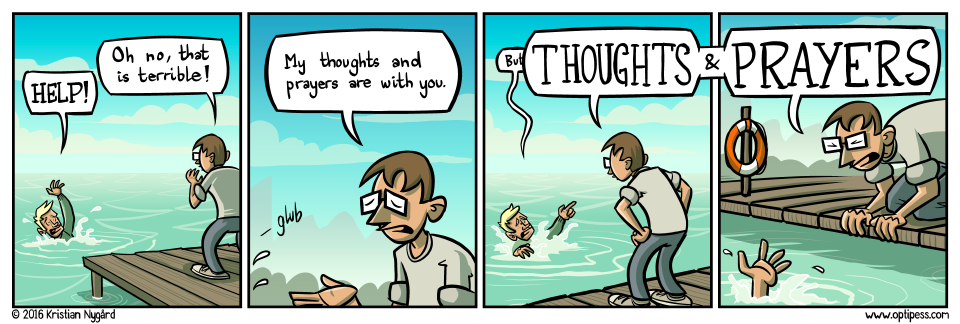
Some Thoughts on "Thoughts and Prayers"

In the wake of the latest school shooting in Florida there has been an upswing in people railing against individuals sending "thoughts and prayers" to the victims. We've all seen/heard/maybe participated in such rantings. For example, there this gem:


http://www.optipess.com/2016/06/17/thoughts-and-prayers/

or there's the visual metaphor:


https://www.atheistrev.com/2017/10/thoughts-and-prayers.html
And so on.

The general thrust of the argument is that thoughts and prayers don't stop school children (or concert goers, or nightclubbers, or church attenders, or etc.) from getting shot. We need action. We need policy. We need to stop/start *insert whichever line of action that best fits your politics/worldview*.

While I completely understand where this line of thinking is coming from, I disagree with it. In fact, I'd go so far as I hate it. I hate people telling other people to stop thinking and praying for others in need. In fact, my argument is the complete opposite:

In the face of tragedy, people need to think and pray more.


The real problem with the "thoughts and prayers" that so many people rail against is that these thoughts and prayers as expressed on twitter or on facebook or on etc. never get beyond the screen. It's a kind of virtue signaling that allows the signaler to feel like a compassionate person before settling in for another 6 hours of netflix or stripping down for a workout in the congressional gym. Is that unfair and overgeneralized? Absolutely. Those who express their "thoughts and prayers" likely aren't setting out to be unfeeling, uncaring, and numb to the real difficulties of the world around them, but that doesn't change the impotence of such expressions when they don't go beyond a couple of thumb-taps on social media. 

But here's the deal: 

That's not thinking and praying!

A prayer isn't just something you say and then go about your life as if nothing had happened. A prayer should be a meditative, reflective act about the nature of life in which you express gratitude for what's going well, ask for help and support in areas of weakness or struggle, and resolve to do/be better in whatever way you can. A prayer uttered in this vein goes beyond the words themselves. It can and should be transformative regarding how an individual lives his/her life. 

Allow me to illustrate what I mean using a scripture from The Book of Mormon. In this scripture a prophet, Amulek, is teaching a group of people about the importance of praying always. (He really emphasizes the "always" part of that.) He wraps up the portion of his discourse about prayer by saying:

"Yea, and when you do not cry unto the Lord, let your hearts be full, drawn out in prayer unto him continually for your welfare, and also for the welfare of those who are around you. 


"And now behold, my beloved brethren, I say unto you, do not suppose that this is all; for after ye have done all these things, if ye turn away the needy, and the naked, and visit not the sick and afflicted, and impart of your substance, if ye have, to those who stand in need—I say unto you, if ye do not any of these things, behold, your prayer is vain, and availeth you nothing, and ye are as hypocrites who do deny the faith.

"Therefore, if ye do not remember to be charitable, ye are as dross, which the refiners do cast out, (it being of no worth) and is trodden under foot of men."

If you pray "for the welfare of those who are around you" but then don't actually do anything to help and improve the actual material welfare of those who are around you, 1) your prayer is in vain, 2) your prayer availeth you nothing, 3) you are a hypocrite who denies the faith, 4) you are dross, cast out and trodden under the foot of men. 

(Okay, so I'm not totally sure how the bit about being "trodden under the foot of men" plays into the discussion here, but it is a pretty fantastic image.)

While I've been talking thus far most especially about this issue from a religious perspective -- the prayers side of things -- I especially like that the common parlance joins thoughts with prayers. It seems to suggest a union of those who are religious and those who aren't terribly keen on religion or overt shows of religiosity. While prayer is a conversation with an individual and his/her/their deity of choice, "thoughts" don't necessarily have to invoke the divine at all. The process I described above isn't exclusive to such belief. 

Anyone can take a few moments out of their day to think and reflect on life, both ours and that of those around us (near and far.) In such a reflection, we can recognize that some things are pretty great (the Jazz are on an 11 game tear, for example), and we can recognize that some things are pretty not great (...unfortunately, you don't need help coming up with an illustrating example on this one). But then rather than just leaving it there, we need push on and ponder about what we can do, individually, to improve the things that aren't great. And then we need to actually do them.

In this way, a thought/prayer for the homeless might look something like this:


A thought/prayer for the hungry might look something like this:
(Except some food banks prefer donations of money to donations of food)
A thought/prayer to relieve those suffering from natural disaster might look like this:


So what does this look like in the face of yet another school shooting? Well, it depends on your sphere of influence. It might mean contacting your government representative and asking them to advocate for a position you believe in. It might mean actually enacting legislation that ameliorates the problems. It might mean just going out of your way to get to know and choose to love somebody who isn't like you.

Thoughts and prayers can go a long way towards improving the world, if for no other reason than they can/should serve as a means of focusing the actions we take to confront the evils of the world. 

That said, at least for me, the need for "thoughts and prayers" goes beyond improving the world and making it a better/safer/more humane place. As a person of faith, prayer in particular provides for me eternal context and a basis for hope and optimism despite the horrors of the world.

As the current prophet and president of the LDS Church, Russell M. Nelson, has said:

“I recognize that, on occasion, some of our most fervent prayers may seem to go unanswered. We wonder, ‘Why?’ I know that feeling! I know the fears and tears of such moments. But I also know that our prayers are never ignored. Our faith is never unappreciated. I know that an all-wise Heavenly Father’s perspective is much broader than is ours. While we know of our mortal problems and pain, He knows of our immortal progress and potential. If we pray to know His will and submit ourselves to it with patience and courage, heavenly healing can take place in His own way and time.”


So yes. Let's think and pray. But more than that, let's allow those thoughts and prayers to drive us to act. As we do, peace and change can be ours.

Sunday, February 26, 2017

On Writing and Struggle and Being a Religious (Mormon) Grad Student

So I'm officially the last person in my cohort to be ABD. I realize that the previous sentence might make it sound like I've recently achieved ABDness myself, so allow me to clarify that no, I have not. Not yet. I'm fine with that. And by saying that I'm fine with it, I'm not trying to convince myself to be fine with it. Really, I am fine with it. I've long since stopped judging my work/ability/value based off of how/what other people are doing. Also, I know very well that I've been working hard, and after several starts and stops and research project ideas and epiphanies and inspirations that weren't actually inspirations but were really just me being a little gassy, I'm on track to defend my prospectus and be ABD by April. So really, I'm fine. And I'm content with where I am in my progress towards graduation.

That said, while I really and truly am fine and encouraged with where I am and where I'm going, it has been and will continue to be hard. I know that very well. I'm a realist here. I knew coming in that it was going to be difficult. It ain't all daffodils and sunshine. (Especially those winters when the arctic death chill came sweeping through the Midwest.) There really are times when it's hard. No, that's not strong enough language. There have been times when it has frankly been miserable. There have been times when I've felt thoroughly inadequate and like I completely don't belong here. There have also been moments of gold and flashes of light - times when I have love love loved what I'm doing and the direction my life is heading.

I feel like the last month or so I've been riding the crest of one of those waves where it all seems to be coming together, and I feel good (I knew that I would.) That might be a-little-bit-more-than-partially due to the fact that I got engaged to an amazingly wonderful woman earlier this month. But on top of the awesomity of Shar and being engaged to her, I just feel like my academic and scholarly pursuits are also looking very positive lately.

This is a picture of me being a scholar. A scholar that needs a haircut, sure, but a scholar all the same. 

And so, anticipating that in the ensuing days, weeks, and months as I writewritewritewritewrite I will descend from the mountaintop and the struggles and difficulties and weaknesses and insecurities will resume, I wanted to write down a few thoughts that I can hopefully return to as a pick-me-up.

Early on in my time here at Purdue, my master's thesis adviser Kristine Hansen gave me some counsel and advice that I often go back and revisit. As a part of that advice she wrote, "It's a long, hard slog to the PhD, but if you take it a day at a time and give each day a good effort, you will succeed." As I was expressing above, it has been a long, hard slog, and I only anticipate it being longer and harder and sloggier before it's all over.

Part of what has made it difficult for me is I feel inadequate with my writing. I'm feeling this inadequacy in writing especially keenly of late as I've been working on several projects: my dissertation prospectus (the thing I have to write and defend before I can officially be ABD), and article I recently resubmitted to a journal, and a couple of conference papers. The fact that I've been actually working on and making progress on these projects has been encouraging, but almost every time I sit down at a computer to compose I feel woefully inadequate. The moment my thoughts begin to taken written form, I'm hyper-conscious of them not being as sophisticated and polished as I want them to be.

The nice thing about this struggle is that I know I'm not alone in it; if nothing else, I have the company of my students. It's kind of funny that I feel like I struggle so much with writing when at the same time I teach and study writing and have been doing so for 5.71875 years now. I'm supposed to be the expert in the classroom, but the only thing I feel expert at is trying to write and failing. And then trying again and failing a little less. And then trying again and failing a little less. And that process continues until I'm reasonably content with the amount of failure on the page. I will say, though, that now that I'm in my 11th year of college, I'm able to work through this pattern of failure and correction much more quickly than in years past. In fact, I may even be getting to the point that Don Murray wrote about where I'm able to "glory in [writing's] unfinishedness." That said, it isn't always as simple as all that. It isn't always easy to quiet the inner voice that says, "you're not enough and you never will be."

Luckily, I'm pretty familiar with that voice, since it's the same one that seems to be talking whenever any aspect of my life seems overwhelming and I feel inadequate. I say that it's a lucky thing because I have a surefire way of combating that naysayer: I turn to the scriptures and to prayer.

When I find myself struggling in writing, I am often able to draw strength particularly from one of my favorite passages of scripture in the Book of Mormon. When I was teaching at BYU I would often share this with my students at the point in the semester when everything seemed to be piling up and the workload was getting to be nearly impossible. I liked doing this because it seemed to help them, but it also did a pretty good job of helping me as I faced similar piling ups and impossibilities. Being at a secular, public institution now I can't share this directly with my students, but I still go back to these verses when I'm feeling particularly unsure of myself.

Actually, before I share the scriptures and why I find them helpful, allow me to share a little bit of context for them.

The scripture comes from the 12th chapter of the Book of Ether in the Book of Mormon. The Book of Mormon is a collection of scripture written by prophets in the Americas from about 600 BC to 400 AD. One of the last prophets, Mormon (for whom the book is named), collected, condensed and abridged the writings of all the prophets in the previous nearly 1000 years of his civilization. He then gave his abridgments to his son Moroni. Moroni, the last man in recorded in the book who was faithful to the Gospel of Jesus Christ, wandered alone with his father's abridgment of sacred records for many years. During his wanderings, Moroni added to his father's compilation by abridging and compiling the Book of Ether, which was derived from prophetic writings of a people that even predated Moroni's own. It is in this context that Moroni is writing (not abridging) Ether 12.

Quick summary:

- Moroni has in his possession and has likely studied extensively his own father's compilation of writings, writings full of wonderful and powerfully written stories, prophecies and sermons.
- Moroni is abridging and writing about several prophets of God, one of whom, according to Moroni, "[God] madest him that the things which he wrote were mighty...unto the overpowering of man to read them."
- Moroni knew, being a prophet himself, that several hundred years in the future the things that he was writing would be found, translated, and spread widely throughout the world.

With the weight of comparison with others greater than himself (according to his perception), and the weight of the expectations of an unseen and probably judgmental future population, Moroni felt unsure and inadequate, and he took his concerns to the Lord:

23 And I said unto him: Lord, the Gentiles will mock at these things, because of our weakness in writing; for Lord thou hast made us mighty in word by faith, but thou hast not made us mighty in writing; for thou hast made all this people that they could speak much, because of the Holy Ghost which thou hast given them;

 24 And thou hast made us that we could write but little, because of the awkwardness of our hands. Behold, thou hast not made us mighty in writing like unto the brother of Jared, for thou madest him that the things which he wrote were mighty even as thou art, unto the overpowering of man to read them.

 25 Thou hast also made our words powerful and great, even that we cannot write them; wherefore, when we write we behold our weakness, and stumble because of the placing of our words; and I fear lest the Gentiles shall mock at our words.

Moroni was nervous that the things he was writing weren't up to snuff. He worried that the people in the future who were reading what he was writing would make fun of him. When I read these verses I see myself, though to a much, much lesser degree. Don't get me wrong, I'm not setting myself up as a prophetic figure in any way, and I surely don't have the same pressures on my writing that Moroni had, but that insecurity. The phrase, "the awkwardness of our hands." Stumbling because of the placing of my words. I can relate to that. A lot.  

The following verses after Moroni recounts his struggles, are, to me, some of the sweetest in all of holy writ:

26 And when I had said this, the Lord spake unto me, saying: Fools mock, but they shall mourn; and my grace is sufficient for the meek, that they shall take no advantage of your weakness;

 27 And if men come unto me I will show unto them their weakness. I give unto men weakness that they may be humble; and my grace is sufficient for all men that humble themselves before me; for if they humble themselves before me, and have faith in me, then will I make weak things become strong unto them.

Verse 27 of Ether 12 is one of the most oft-quoted verses throughout The Church of Jesus Christ of Latter-day Saints, and more often than not it gets used in the context of weakness in general. In any area in which we feel weak, in any area in which we feel like we are not enough, in any struggle, insecurity, or slog, we can find strength in the grace of Christ. As we humble ourselves before Christ and find and build our faith in Him, His ennobling and empowering Atonement can provide us with the ability to overcome whatever weakness we need to overcome.

I believe that to be true in the general application of the scripture, but I love that the direct context of the passage - the particular weakness in question - was the struggle to write.

Many times over the past several years I have found myself in positions where I feel like I can't do what's being asked of me, that I can't write what I need to write. But in every one of those instances, as I have knelt down to pray and ask for divine help and strength to enable me to write beyond my ability, that divine help and strength has come. In every case. I have been able to complete the tasks before me, and even on occasion I have been able to feel pretty good about my work.

So as I go forward with the coming writings that are sure to push me well beyond where I'm capable, I know in whom I have trusted previously, and I know that I can have the confidence to do all things with His help.


Quick end note: A year or so after coming to Purdue, a professor of mine from BYU, Trent Hickman, gave a devotional address about this same idea that I very highly recommend. I felt validated knowing that he too struggled sometimes, and that he had found similar comfort in these scriptures.

Tuesday, August 30, 2016

My Brain Is a Jerk

But for real. He is. He's like that guy who shows up after all the work is done and pretends to be disappointed that he can't be of more help. He shows up just when his usefulness (in its proferred capacity) is of no use because there are other things to be taken care of. Just now I sat down in class and he immediately started saying, "Hey I want to do that thing I've been dragging my feet on all summer. Whadya say? Oh, you have to go spend an hour and a half doing something that you're obligated to do and that is sure to suck any and all motivation? Well darn. Maybe next time." Except he knows that there will be no next time. Or at least it's gonna be a long while before he comes back again. Like I said. He's a jerk.